Designing Flow Friction: The Core Capability of AI-Native Teams
on , tagged translations, ai, processes, product-management, engineering-management (share this post, e.g., on Mastodon or on Bluesky)
Over the past few years, discussions about AI’s impact on software development have primarily focused on individual productivity: How long does it take to build a feature? How many tasks can a developer handle simultaneously? How much code can a coding agent generate? AI has indeed significantly reduced execution costs—what once took days to implement can now enter a pull request after just a few hours.
But developers working faster does not mean teams scale proportionally. While code, pull requests, and tests increase, the time from requirement to user value has not shortened at the same rate. Requirements, design, reviews, merges, testing, and releases still queue up, and localized speedups make end-to-end delivery even more unstable.
AI is shifting software development from a production capacity problem to a flow capacity problem. As the marginal cost of code generation drops, the real bottleneck for teams becomes whether requirements, design, validation, and feedback can move through the system at a matching pace.
AI’s Acceleration Across Team Roles Is Uneven
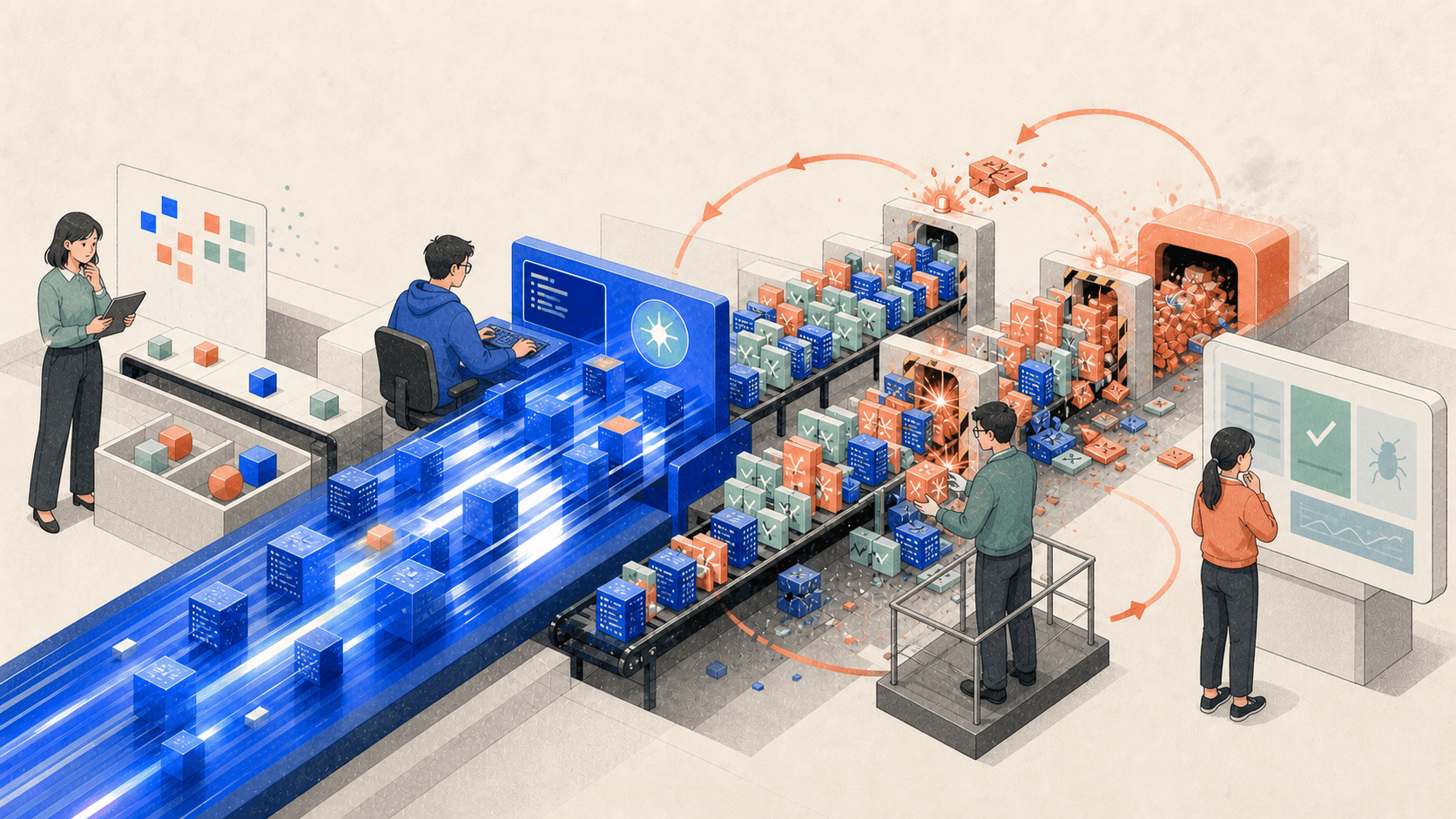
If AI could uniformly increase every role’s output fivefold, teams might only need to scale overall throughput. Reality, however, is different. AI’s impact varies dramatically across tasks: It excels at generating text, code, pages, and test skeletons but cannot match that speed for customer interviews, organizational decisions, business trade-offs, user validation, or cross-team coordination. This uneven acceleration disrupts the team’s once-stable workflow.
Product Work Is Constrained by Decision-Making, Not Documentation
Product managers can certainly use AI to quickly organize meeting notes, generate user stories, analyze competitors, or even produce numerous requirement hypotheses. But the real bottleneck in product work is rarely writing requirements—it’s gathering enough information and making decisions. If customer meetings aren’t held, key stakeholders aren’t engaged, business goals remain unclear, or priority conflicts persist, even the most detailed user stories are just unconfirmed assumptions.
In the past, if a product manager delayed confirming a requirement by a day, the development team might still be finishing the previous batch of features, and the delay would be absorbed by the longer development cycle. Now, developers and agents might consume all prepared tasks in just a few hours. A product manager returning from a half-day of meetings could find the development team with no mature requirements left to advance. The issue isn’t the product manager’s inefficiency or developers’ impatience—it’s that the development stage’s consumption speed has outpaced the team’s ability to produce validated decisions.
This also explains why “having product managers use more AI” only partially alleviates the problem. AI can help product managers explore possibilities faster, but it can also generate more requirements, alternatives, and assumptions that need confirmation. More requirements don’t equal more validated requirements ready for development. What remains scarce are requirements that have undergone business judgment, user validation, and team alignment.
Design Work Is Constrained by Experience Judgment, Not Drawing Speed
Designers face similar challenges. AI can rapidly generate multiple pages, interfaces in different styles, or even a full prototype. But the core of design work isn’t just creating pages—it’s understanding user journeys, handling empty states, edge cases, permission differences, and responsive behaviors. Designers must balance product goals, technical constraints, and design systems while ensuring that what seems reasonable is actually understandable and usable by users.
Once development capacity increases significantly, designers can easily become the upstream bottleneck. A design might only cover the main flow, yet developers immediately ask about error handling, bulk operations, mobile experiences, and edge cases. To avoid delays, developers and agents might fill in these gaps themselves using existing components and common patterns. Local progress continues, but experience decisions that should have been unified by the designer become fragmented across different agents and code branches.
In the end, designers don’t have less work—they must retroactively review, correct, and unify decisions already implemented in code. Explorations and trade-offs that should have happened during the design phase are postponed as rework after development. Insufficient design capacity doesn’t just make developers wait; it also tempts them to prematurely consume immature inputs, amplifying discrepancies into more code changes.
Development Faces Both Upstream Starvation and Downstream Congestion
Thus, an AI-native team may simultaneously experience two seemingly contradictory states: On one hand, developers feel there aren’t enough requirements or designs to continue working, leading to upstream starvation. On the other, the generated code piles up in review, merge, and testing stages, causing downstream congestion. The team isn’t lacking work—it’s just distributed unevenly across the value stream, unable to flow forward smoothly.
This is AI’s most counterintuitive impact on team flow. Improved development capacity doesn’t simply push the entire value stream forward—it first alters the existing capacity ratios between stages. When requirement decisions increase by 1.2×, design delivery by 1.5×, code production by 5×, and review and testing only by 1.3×, the development stage resembles a suddenly widened highway: The entrance lacks enough vehicles, and the exit can’t handle the traffic already on the road.
How Local Speedups Become Systemic Rework
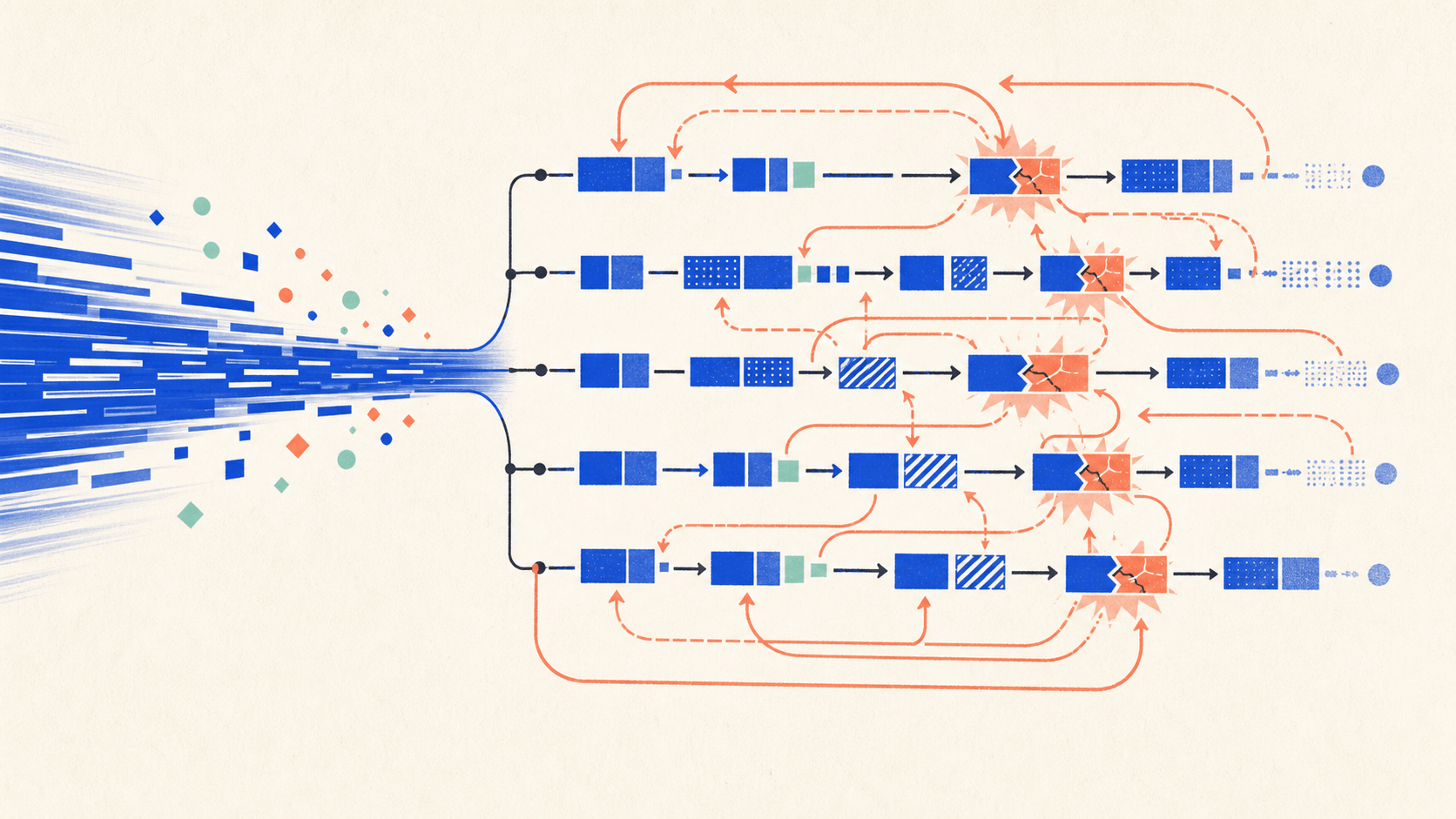
When development outpaces upstream and downstream, teams often have agents explore ahead, refactor, or add more tests to fill capacity. While these tasks have value, they continuously add unfinished changes, turning local speedups into systemic rework.
Immature Requirements Become Code Faster
In the past, requirement ambiguities would gradually surface during development. Now, agents can quickly choose a reasonable interpretation based on context and implement it fully. The ambiguity doesn’t disappear—it’s just solidified into code faster.
For example, “admins can export member lists” doesn’t specify the admin’s permission model or which data to export. Frontend, backend, and testing agents might each produce locally reasonable implementations that don’t necessarily reflect the same business decision. By the time discrepancies surface during review, a single clarification question has become a set of changes requiring modifications to code, tests, documentation, and interfaces.
More Parallel Development Creates More Merge and Ownership Issues
With faster development, teams naturally increase parallelism. Git conflicts are just the surface issue—even if code merges, different agents might introduce varying abstractions, naming conventions, and error-handling approaches in adjacent modules.
Each pull request might look correct in isolation, but together, they lose consistency. Authors’ confidence stems from complete interactions with agents, while reviewers only see the final diff. Code review shifts from code inspection to context recovery. AI reduces the cost of writing code but increases the cost of collective code ownership.
More Tests Don’t Equal More Validation
AI excels at supplementing tests based on implementations, but more tests don’t equal greater validation capacity. Tests generated from implementations easily prove “the code runs as written” but not necessarily “the system implements the correct business behavior.”
Parallel changes also expand the combination space that needs validation. Testing teams must not only select tests that truly correspond to risks, interpret results, and locate failures but also help upstream recover intent and uncover divergences. The later problems are discovered, the more time saved during development is offset by bug fixes, regression testing, and repeated deliveries.
AI-Native Teams Need to Optimize the Flow of Change
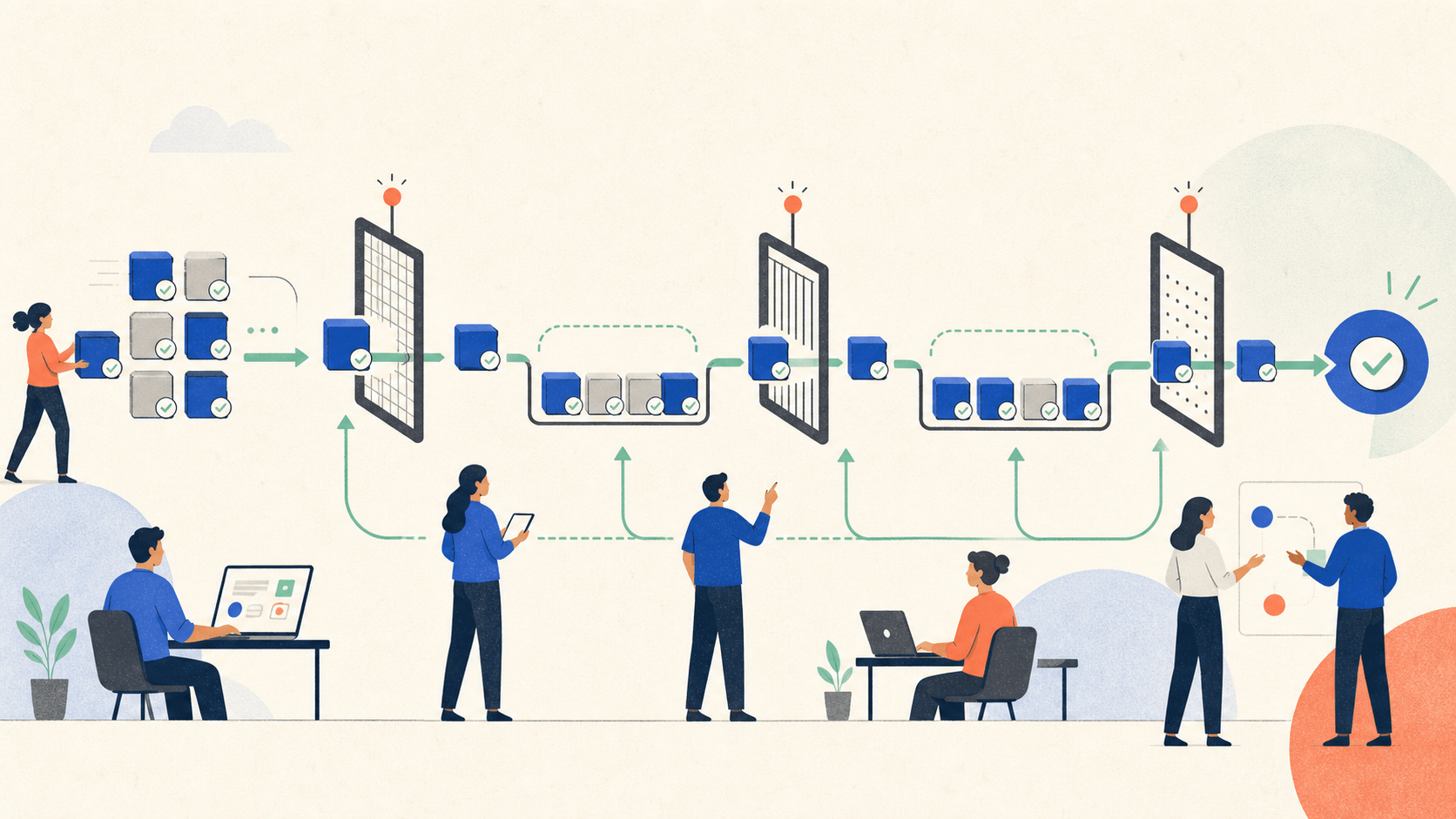
The solution isn’t to restrict agents or have product, design, and testing teams chase development’s peak speed. AI’s acceleration is inherently uneven across roles, so teams must optimize how changes enter the system, cross roles, and get validated. The goal isn’t to make every stage busier but to enable work to flow through the entire value stream with less waiting and rework.
Form minimal decisions first. Requirements don’t need to be longer. Teams only need to confirm business semantics, core paths, risk boundaries, and completion criteria before generating large amounts of code, ensuring critical divergences emerge at the cheapest possible time.
Absorb development capacity with small batches. AI’s advantage should shorten the implementation cycle of small batches, not expand the size of requirements and pull requests. Smaller changes receive feedback earlier and are easier to review, test, merge, and roll back.
Deliver context and evidence with code. A reviewable change shouldn’t only include code and auto-generated summaries—it should also include goals, key assumptions, impact scope, validation results, and remaining unknowns to reduce the cost for reviewers to reverse-engineer context.
Use backpressure to control parallelism. When review, testing, or integration is saturated, increasing development parallelism only creates inventory. Teams should reduce new feature concurrency or redirect agents to supplement validation, organize context, and eliminate existing risks.
Code Is Already Fast Enough—What’s Truly Scarce Is Team Flow
Traditional software engineering has long revolved around production capacity. We’ve optimized languages, frameworks, build systems, deployment platforms, and development environments to produce software faster and more reliably. Coding agents further reduce code production costs, making development—once the primary bottleneck in the value stream—potentially the fastest stage.
Once this shift occurs, teams can no longer focus solely on optimizing development. Can products continuously form effective decisions? Can design deliver consumable experience boundaries in time? Can code safely parallelize in small batches? Can reviews obtain sufficient context? Can testing validate true business behavior? Can production feedback loop back into the next round of decisions? These factors collectively determine whether changes can continuously flow through the entire system.
The competitiveness of AI-native teams doesn’t lie in how many agents they can run simultaneously or how many requirements, prototypes, code, and tests they can generate in a day. What truly matters is how many changes can flow from an unconfirmed idea to user-perceptible value with minimal waiting, conflict, and rework.
Code may already be fast enough. What truly needs redesigning is the entire team’s flow.
(This post is a machine-made, human-reviewed, and authorized translation of phodal.com/blog/ai-native-team-flow/.)