
Comparing the Top 3 A/B Testing Solutions for Frontend Teams
by @eleanorhecks.bsky.social (@designerly.bsky.social) on , tagged guest-posts, a-b-testing, comparisons (share this post, e.g., on Mastodon or on Bluesky)
A/B testing gives frontend teams a practical way to validate design and development decisions with real user data. Choosing the right platform can make a significant difference in how quickly teams launch tests and turn insights into product improvements.
Why Frontend Teams Need A/B Testing
A/B testing—comparing two versions of a single element with segmented user groups—is a well-established practice in the marketing space for making data-driven decisions. But it has evolved far beyond that domain.
Today, many frontend teams use A/B testing to validate design and interface decisions through real user behavior before implementing major changes like feature rollouts or redesigns. Rather than relying on assumptions, teams can measure how actual users interact with different variations and use those insights to justify decisions with confidence.
This systematic, scientific approach answers critical design questions, such as which layout performs better or whether a new interaction pattern confuses users. By comparing multiple versions of a page or component, teams gain clarity on what works—and what doesn’t—while significantly reducing the risk of launching underperforming interfaces.
Common benefits include:
- Data-driven decision-making
- Improved user experience
- Higher conversion rates
- Reduced bounce rates
- Better allocation of engineering effort
Key Areas for A/B Testing in Frontend Development
While not every frontend decision needs a test, several categories produce consistent, high-value results. A/B testing usually takes around 35 days, so planning and strategy are essential to make the most out of this period. Here are some key aspects to look at:
- UI layout and visual hierarchy: Teams test different layouts, navigation structures, and visual hierarchies to identify which version improves task completion and engagement.
- Call-to-action (CTA) elements: Frontend teams test variations in wording, placement, color, and size to improve click-through rates.
- Content placement and density: Teams compare where information appears on a page, including hero sections, website copy, product details, and images, to determine what draws attention most effectively.
- Performance and load speed: Frontend teams test image formats and script delivery methods to observe how performance changes affect user behavior.
- Mobile vs. desktop variations: Designers evaluate mobile and desktop experiences separately to identify device-specific issues and improve consistency.
3 Top A/B Testing Platforms for Frontend Teams
Here are three of the most widely adopted experimentation platforms for frontend teams.
1. Optimizely
Optimizely is a widely adopted experimentation platform used heavily in enterprise environments where structured testing matters. Its primary appeal lies in its well-developed infrastructure and support for both client-side and server-side experimentation.
Optimizely is best for large teams running structured experimentation programs with detailed analytics needs.
Strengths include:
- No code required for product and marketing teams
- Detailed experimentation analytics
- Fast, flicker-free testing
Limitations include:
- No public pricing details
- Setup and onboarding requiring significant coordination
2. VWO
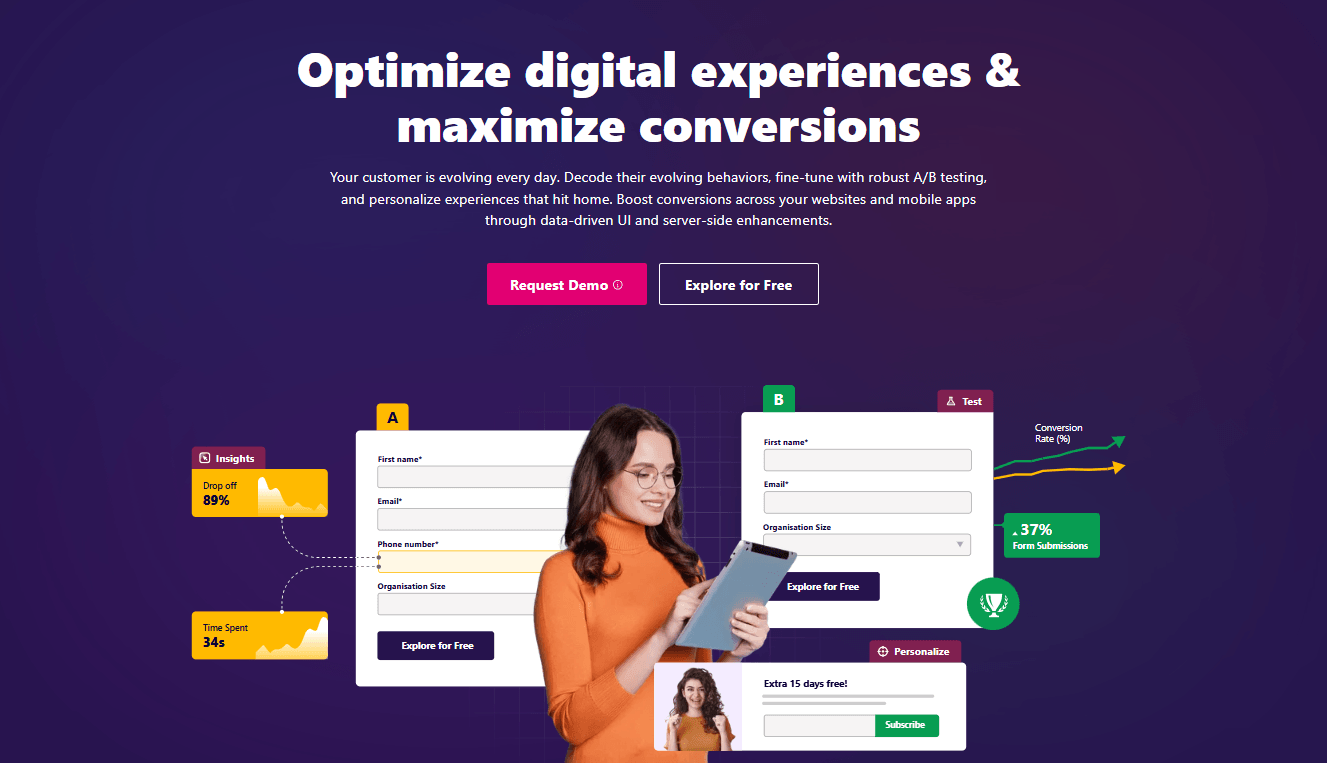
VWO provides a balance between usability and experimentation depth, making it a common choice for UI-focused optimization work. It focuses on helping teams launch tests quickly and gather actionable insights without extensive setup.
VWO is best for teams focused on UI improvements and conversion optimization.
Strengths include:
- Visual editor enables quick test creation
- 30-day free trial
- Precise audience targeting
Limitations include:
- Tiered plans with no public pricing details
- Steep learning curve
3. AB Tasty
(Note: In January, VWO and AB Tasty announced their merger.)
AB Tasty supports both experimentation and personalization, making it useful for teams working across product and growth functions. Frontend teams can use AB Tasty to run standard A/B tests, multivariate experiments, personalized experiences, and more in one place.
AB Tasty is best for teams connecting test efforts with broader customer experience initiatives.
Strengths include:
- Combines testing and personalization
- Supports multiple experimentation methods
- Useful audience segmentation capabilities
Limitations include:
- Less engineering-centric than other tools
- Lack of native integrations with other tools
A/B Testing Platforms at a Glance
| Tool | Best For | Developer Control | Learning Curve |
|---|---|---|---|
| Optimizely | Enterprise-scale experimentation | High | High |
| VWO | UI experimentation and analytics | Medium | Medium |
| AB Tasty | Experimentation with personalization | Medium | Medium |
Turning Insights Into Better User Experiences
The platform itself—whether Optimizely, VWO, or AB Tasty—is just the first step. What matters then is how you use it. The most successful frontend teams make A/B testing a continuous practice—not a one-off exercise. Test regularly with metrics that are clearly defined before the test’s launch, give experiments enough time to have statistical impact, and thoroughly document results to build team-wide knowledge. A modest platform used consistently will deliver more value than an enterprise-grade solution that goes underutilized.
(At Frontend Dogma, we accept guest posts as long as they aren’t predominantly AI-generated or promotional. While all guest posts are reviewed, we cannot and do not vouch for their accuracy, nor do we necessarily endorse recommendations made within them.)